
About Waajji
A studio that tests social science with playful products.
Waajji is a studio of social behaviorists, economists, game designers, and philosophers. We build playful things that test social science — because people are most honest when they are playing, and a finding is most useful when it is playable.
The studio
Waajji began in 2025 with four chairs and one argument. A sociologist said people could be understood. An economist said they could be priced. A game designer said they could be designed for. A philosopher asked what any of it meant. The argument never ended — it just moved into a workshop, and the workshop started making things.
That is the studio's method: take a question about people and operationalize it — turn a theory that cannot be asked into a situation that can be played. Each product is a small field experiment, and everyone who plays it is a collaborator — because in the social sciences, the observer is always part of the observation.
Products as social instruments
We design objects, brands, and network tools that make people behave like themselves — curious, tangible, and a little strange on purpose.
The homepage introduces two working principles; all four are collected here.
Read on the homepage →Two lines, one studio
Unfiltered (physical, with Team Tartulus) and Team Wik20 (network). Same studio, same question — different materials.
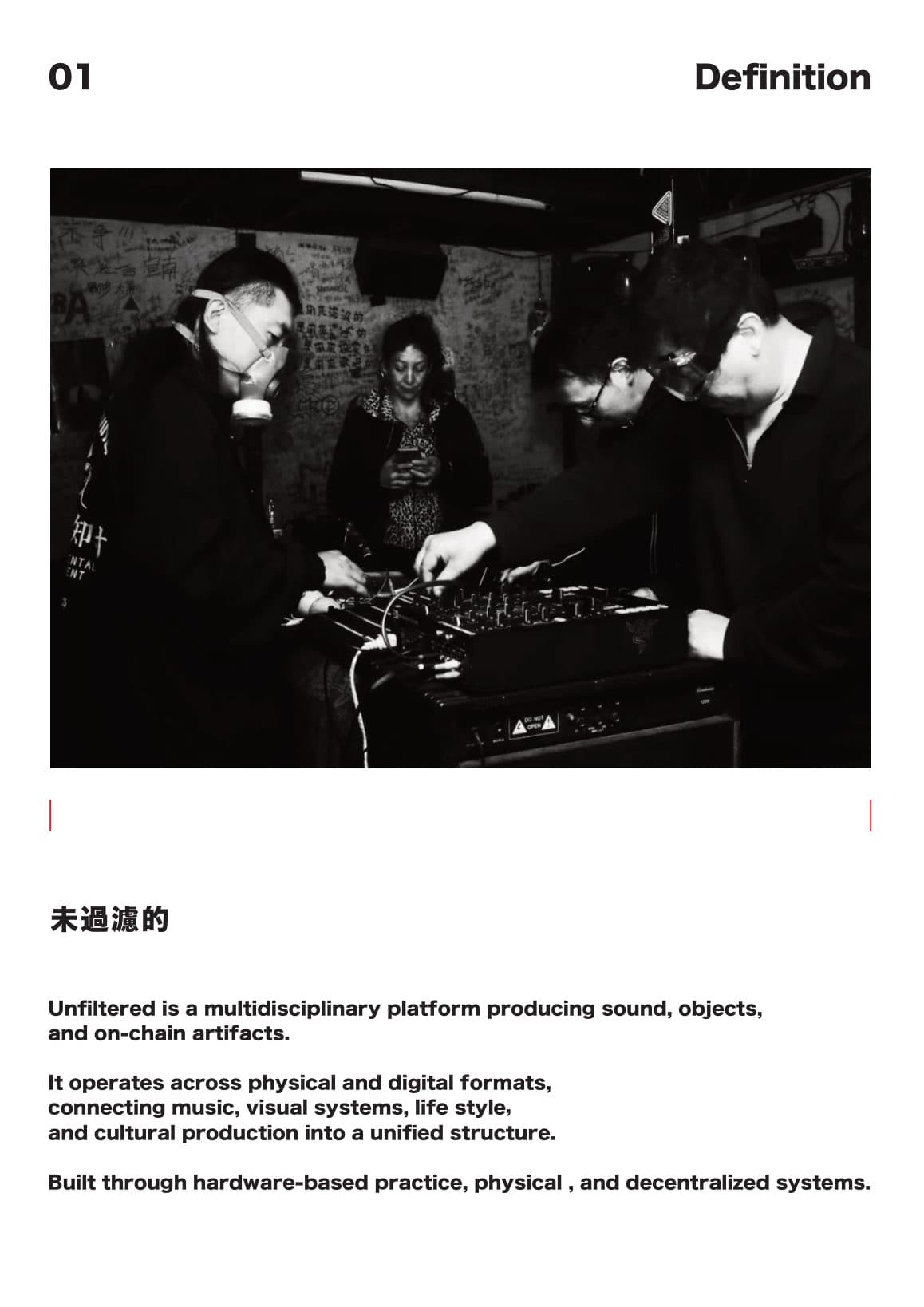
- Unfiltered — Offline / physical — with Team Tartulus
- Team Wik20 — Online / network
Questions, answered plainly
Quick answers before the deeper reading.
What exactly does Waajji make?+
Physical brands and network projects. Unfiltered builds sound, objects, and on-chain artifacts — synthesizers, clothing, lifestyle goods, music releases. Team Wik20 builds learning tools and games — Investment Lesson, DeckX, and Duck Derby. Everything is designed as a small social experiment you can use.
What does 'sociological products' mean?+
Products designed to test how people behave — how they gather, trade, play, bluff, and make meaning. We believe a good hypothesis about people should be something you can wear, hear, or play. The product is the experiment; the users are the data; the fun is the point.
Who is behind Waajji?+
A team of social behaviorists, economists, game developers, and philosophers, founded in 2025. The studio runs two lines: Unfiltered (with Team Tartulus) for the physical side, and Team Wik20 for the network side.
Is Waajji a company or a collective?+
A registered company — 哇嘰網路科技有限公司 — that works like a studio. We use the name Waajji everywhere publicly.
Are the projects free to use?+
The ones that are live are open: Investment Lesson's core stages are free. Unfiltered products are physical goods with real prices. DeckX is in open testing — sit at the table on waajiigames.com if you want to try it. Duck Derby is still in development.
How can I collaborate or get in touch?+
Write to hello@waajji.com. For Unfiltered specifically, find @UFLT_ASIA on X or unfiltered_asia on SoundCloud. Collaborations, press, and curious inquiries are all welcome.
The theory shelf
Why the experiments look this way
What is live → homepage. Why it works this way → here.
A short history
2025
Waajji is founded
Four disciplines, one argument, and a workshop that started making things. The two lines take shape: Unfiltered for the physical, Wik20 for the network.
Open →2025
Investment Lesson opens
The first Wik20 project goes live: a public money-education course that teaches finance and mathematics together — free at its core, with AI learning reviews and browser-run experiments.
Open →2025
Unfiltered takes shape
The brand manual is written: a platform for sound, objects, and on-chain artifacts across Macau, Tokyo, Taipei, and Brisbane. The SC synthesizer series, seasonal clothing, and the first on-chain works follow.
Open →2026
The games come
Mindseeker's Shokunin's Training ships as a public demo on itch.io. DeckX and Duck Derby take shape — the exchange-card game and the strategy duck-racing arena.
Open →2026.09.07
DeckX opens for testing
The exchange-card game is open for play — sit at the table if you want to try it. Duck Derby is still queued.
Open →Start a conversation
Collaborations, press, and curious inquiries. If you read the field notes and want to be part of the next experiment, write to us.